Introduction
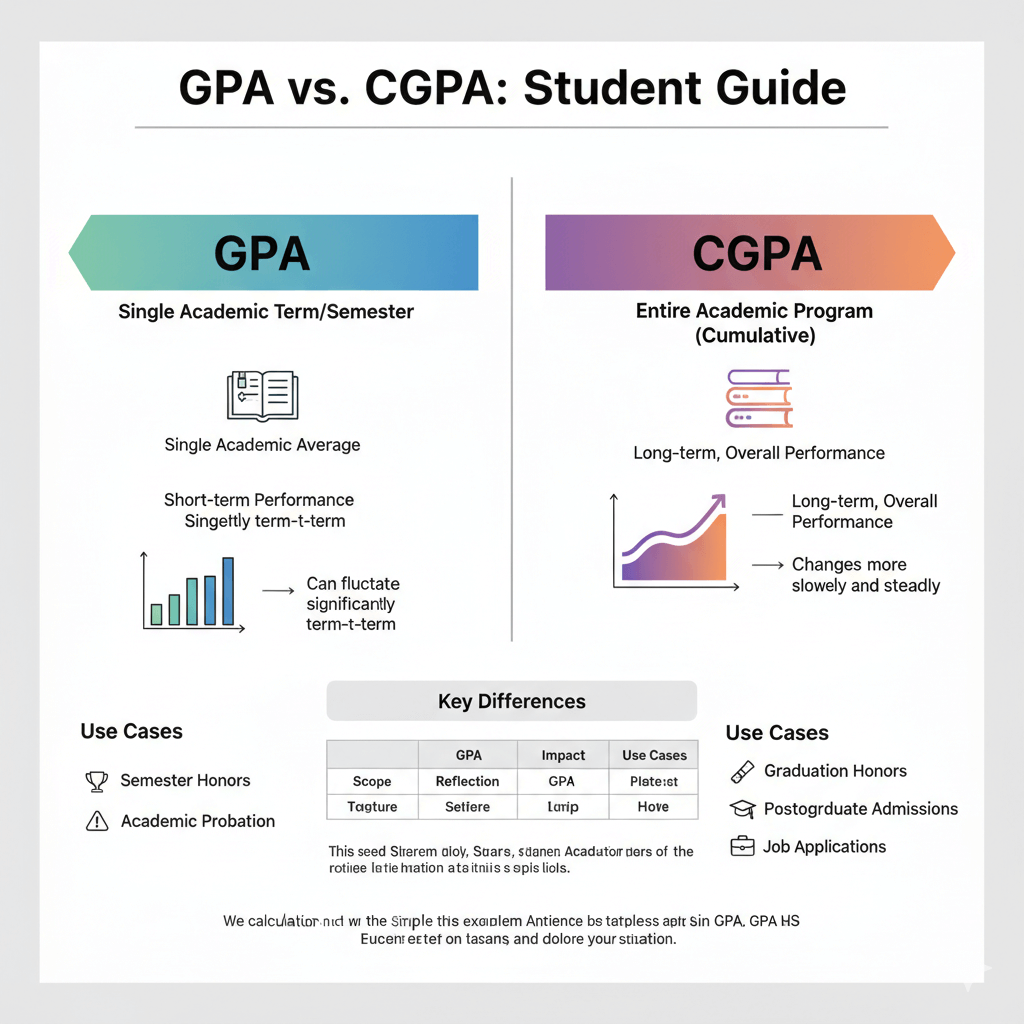
Perhaps one of the most frequently asked questions by students is: "What's the difference between GPA and CGPA?" They may appear to be the same at first glance, as both are Grade Point Averages and both reflect your academic performance. But there's a significant difference:
- GPA (Grade Point Average): Average for a **single semester or term**.
- CGPA (Cumulative Grade Point Average): **Overall average** of all semesters taken together.
Recognizing this distinction is important. Whether you are in middle school, high school, or college (such as LSU, UT Austin, Purdue, Auburn University, UF, or UIUC), your GPA and CGPA can impact college admissions, scholarships, and even employment.
What is GPA? (Grade Point Average)
The **Grade Point Average (GPA)** reflects your performance for a single, finite academic term or semester. It is a snapshot of how well you did during those few months.
Simple GPA Example (Unweighted)
If you take 4 classes during the Fall semester and assign standard 4.0 scale points:
- Math: A ($\text{4.0}$)
- English: B ($\text{3.0}$)
- Chemistry: A ($\text{4.0}$)
- History: C ($\text{2.0}$)
The GPA is calculated by averaging these grade points:
This 3.25 GPA holds good only for that specific semester.
What is CGPA? (Cumulative Grade Point Average)
The **Cumulative GPA (CGPA)** is your total GPA over several semesters. It provides the long-term, comprehensive view of your academic performance from the beginning of your program (e.g., from the start of high school or college).
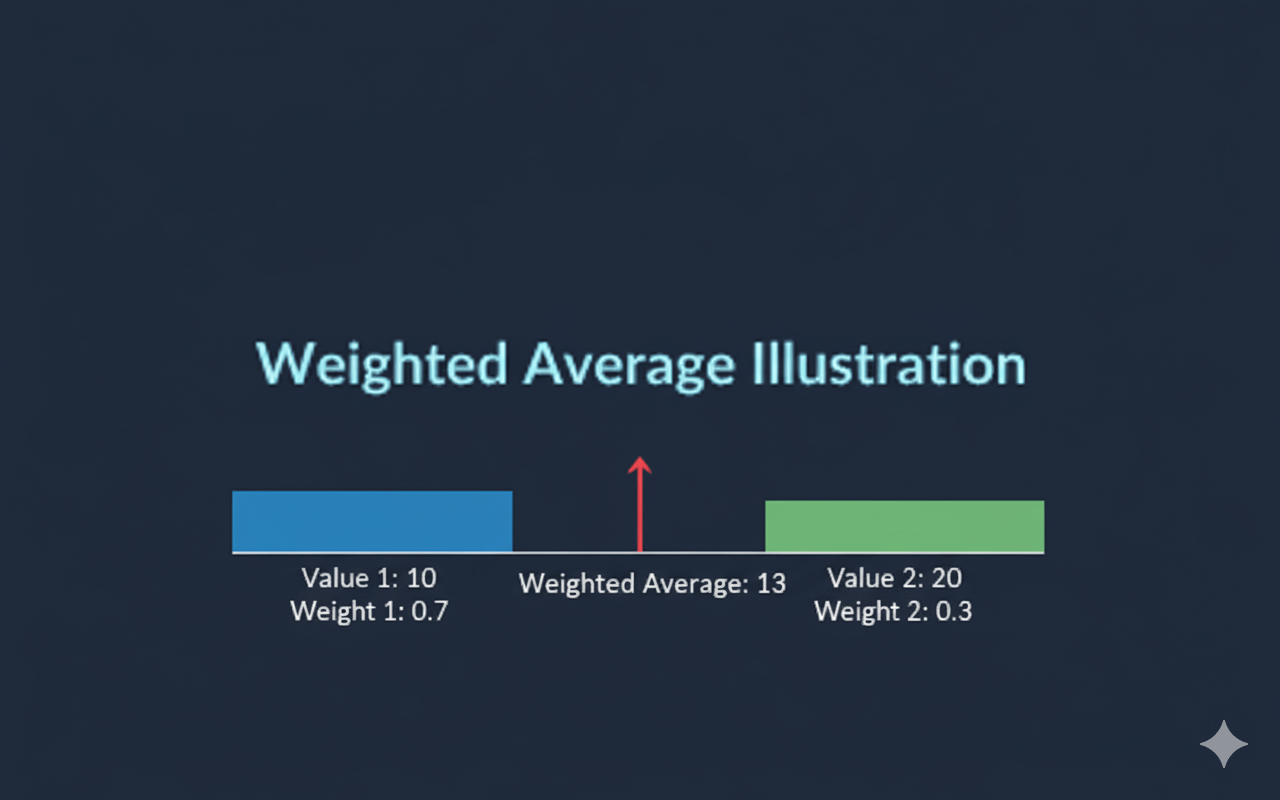
CGPA is a Weighted Average
In most high school and college systems, CGPA is not a simple average of semester GPAs. Instead, it is a **weighted average** based on the total number of credit hours completed. Classes with more credits (like a 4-credit science lab) impact your CGPA more than a class with fewer credits (like a 1-credit elective).
GPA vs CGPA Calculation Example (Weighted)
Here's how credit hours factor into the overall CGPA calculation:
Data from Two Semesters
| Semester | GPA | Credit Hours | Quality Points (GPA $\times$ Credits) |
|---|---|---|---|
| Fall | 3.25 | 15 | 48.75 |
| Spring | 3.75 | 18 | 67.50 |
Calculating CGPA
Total Quality Points = $48.75 + 67.50 = 116.25$
Total Credit Hours = $15 + 18 = 33$
Even though the two semester GPAs were 3.25 and 3.75, the CGPA is 3.52 because the Spring semester (3.75) had more credit hours (18) and was weighted more heavily.
Key Differences Between GPA and CGPA
Use this comparison to quickly understand the role of each metric in your academic life:
| Feature | GPA (Semester GPA) | CGPA (Cumulative GPA) |
|---|---|---|
| Time Period | Whole semester/term | Whole academic past |
| Focus | Recent performance | Overall, consistent performance |
| Importance for Progress | Good for mid-term check and probation warnings | Crucial for graduation and overall standing |
| Primary Use Case | Term-specific scholarships, Deans' List | College admissions, graduation, job applications |
Why GPA and CGPA are Important
- College Admissions: Top schools like UT Austin, Purdue, UIUC, and UC Berkeley tend to look at both—your CGPA for consistent performance and your recent GPAs for an upward trend.
- Scholarships: Most scholarships require a high CGPA but often mandate a minimum GPA each semester to maintain eligibility.
- Graduation Requirements: Nearly all colleges require a minimum CGPA (often 2.0 or higher) to officially graduate.
- Job Applications: Many employers, especially for entry-level professional roles, request your Cumulative GPA to assess your consistent academic dedication.
GPA & CGPA Calculators for Students
Rather than calculating these figures by hand, use an accurate online calculator. They save time and prevent calculation errors. There are often specific calculators tailored to a college's credit system:
- LSU GPA Calculator / Cumulative GPA Calculator LSU
- UT GPA Calculator / UT Austin GPA Calculator
- UF GPA Calculator / GPA Calculator UF
- Purdue GPA Calculator / GPA Calculator Purdue
- TAMU GPA Calculator / GPA Calculator TAMU
- UIUC GPA Calculator / GPA Calculator UIUC
- UVA GPA Calculator / GPA Calculator UVA
FAQs on GPA vs CGPA
1. Is CGPA more significant than GPA?
Yes. **CGPA** reflects your entire academic history, so colleges and employers generally place more value on it as an indicator of consistency. However, a strong recent **GPA** shows you're currently performing well, which is also highly important, especially if you had a weak start.
2. Can I quickly increase my CGPA?
While you can always improve your academic standing, increasing your **CGPA** takes time. Because it accumulates across all semesters, it has high inertia. The best way to increase it is to consistently earn high GPAs in semesters that include high-credit courses. The higher your credit total, the harder it is to move your CGPA significantly with a single term's GPA.
3. What are Quality Points?
Quality Points are the raw total of grade points earned in a semester. They are calculated by multiplying the numerical grade (e.g., $4.0$ for an A) by the credit hours for that course. This number is what makes CGPA a weighted average.
Conclusion
Both GPA and CGPA are essential tools for measuring academic success, but they serve different purposes. Your semester GPA is a critical check-in, while your Cumulative GPA is the metric that will ultimately determine your graduation standing and is heavily weighed during major applications and post-graduation opportunities. Keep track of both, set high goals for your semester GPA, and watch your CGPA climb toward success!

Weighted CGPA Formula
Used by most high schools and colleges.
Key Distinction Summary
| Metric | Period | Used For |
|---|---|---|
| GPA | Term/Semester | Eligibility, Probation |
| CGPA | Overall Academic Career | Admissions, Graduation |
Next Steps
- Know Your School's Grading Scale
- Focus on High-Credit Courses
- Monitor CGPA Trends